
DeKalb Scheduled and Actual Release
A projection is a future calculation. An actual release is a completed custody event. Daviess/DeKalb Regional Jail’s JailTracker can use both “Sched Release” and “Date Released,” while MODOC documents a different state-prison field called “Sentence-I Minimum Release Date.” Each label answers a narrower question than “when will this person be free?” A scheduled field may change. An actual out date can still mark transfer to another jail, MODOC, USMS, or ICE rather than release to the community.
Pretrial detainees do not have a computed sentence-completion date. Their exit may depend on posting bond, a recognizance order, dismissal, a plea and sentence, or resolution of another hold. Case.net can show the legal order, but the regional jail records the physical out time. For a sentenced person, the operative calculation may incorporate prior custody credit, multiple cases, the governing statute, and later court or correctional action.
Find a DeKalb Projected Date
Start with the place and legal authority holding the person. A DeKalb arrest commonly leads to Daviess/DeKalb Regional Jail in Pattonsburg. A Missouri prison sentence leads to MODOC, including Crossroads Correctional Center in Cameron. A federal case belongs in the federal custody chain. Searching the wrong system can produce a blank result or a date from an unrelated stage.
- Identify whether the person is pretrial, serving a regional-jail term, committed to MODOC, under state supervision, or in federal custody.
- For a current regional-jail booking, use the jail-linked JailTracker and compare “Sched Release” with “Date Released.” Then call 660-367-2200.
- Use Missouri Case.net to find the controlling DeKalb County case, judgment, sentence, bond order, and credited custody.
- For a state prisoner, search the MODOC active Offender Search by DOC number when available. Read status, assignment, sentence, parole, and conditional-release information.
- If the person has fully discharged or the active screen lacks the needed field, use the nightly MODOC Sunshine file and its current data dictionary.
- Ask the actual custodian for a release or movement record before treating any projected field as the final event.
The active MODOC search covers people currently incarcerated or under supervision. That means a person released from prison to parole may still appear, but a person whose sentence finally discharged may not. The nightly Sunshine file covers people who are or have been under department supervision. It is the better historical source, although its coded values must be read with the current layout and code tables.
The starting interface can be reviewed on the official MODOC active Offender Search.
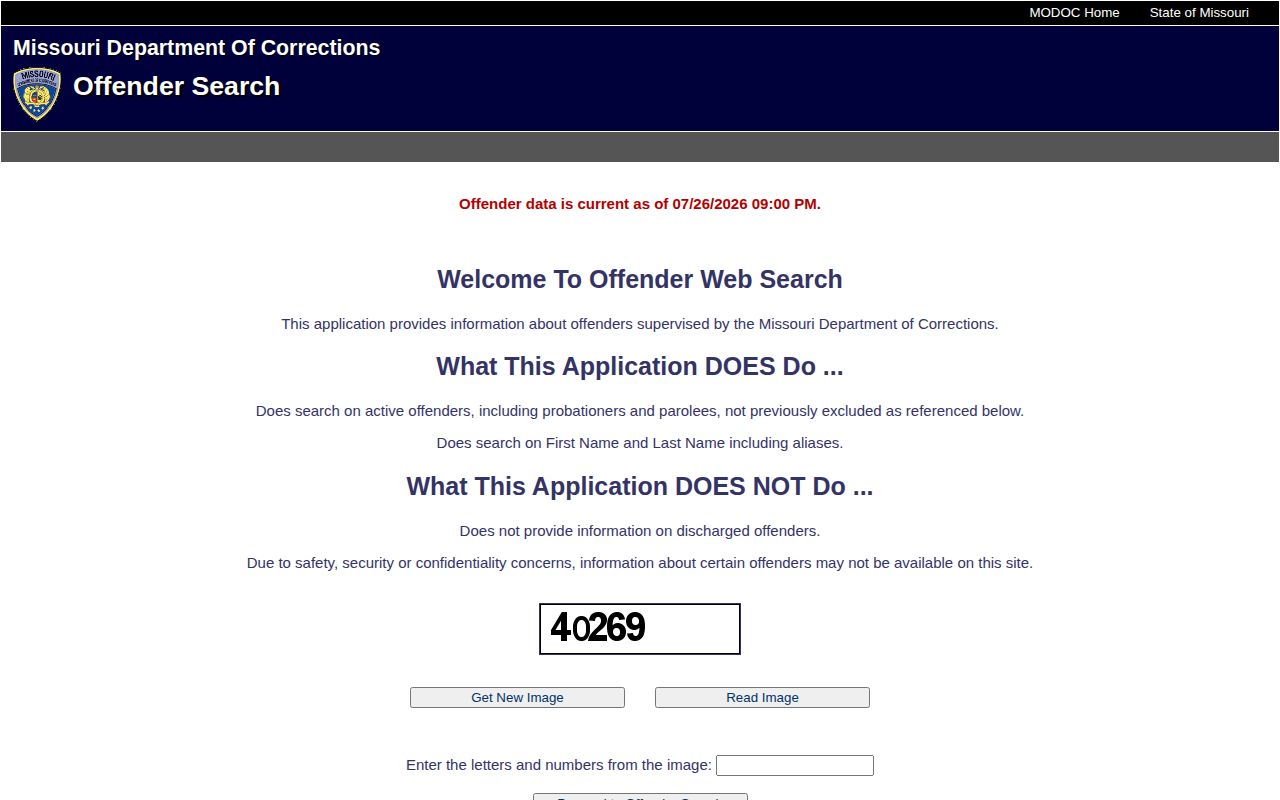
The form is for active incarceration or supervision, which is why a final discharge may require the separate Sunshine history.
Note: Use a DOC number, booking number, or case number when possible. A matching name alone is not enough to establish identity.
DeKalb MODOC Release-Date Field
MODOC’s Sunshine data dictionary labels field $PC as “Sentence-I Minimum Release Date.” The date is stored in YYYYMMDD form and is calculated as the minimum release date for the active sentence. That official name should be preserved. Calling it a guaranteed exit date would erase the limits built into the record and could misstate the person’s actual status.
The same data set includes DOC number, identity fields, assignment and status codes, county and court case, offense, sentence start and length, maximum or expiration calculations, parole and conditional-release information, and probation or parole district codes. These concepts help test a projection. A field-office assignment points to active supervision, not prison confinement. An institutional assignment indicates custody. A past offender may require a movement or release record to identify the completed event.
The MODOC Sunshine page provides the nightly archive and dictionary. Download both together because codes and layouts can change. Record the file date used. A public minimum-release value should be reported with its label and access date, followed by a clear statement that MODOC or the current custodian must confirm the actual release.
The official Sunshine database page also shows where the nightly all-and-past-offender file and field documentation are published.
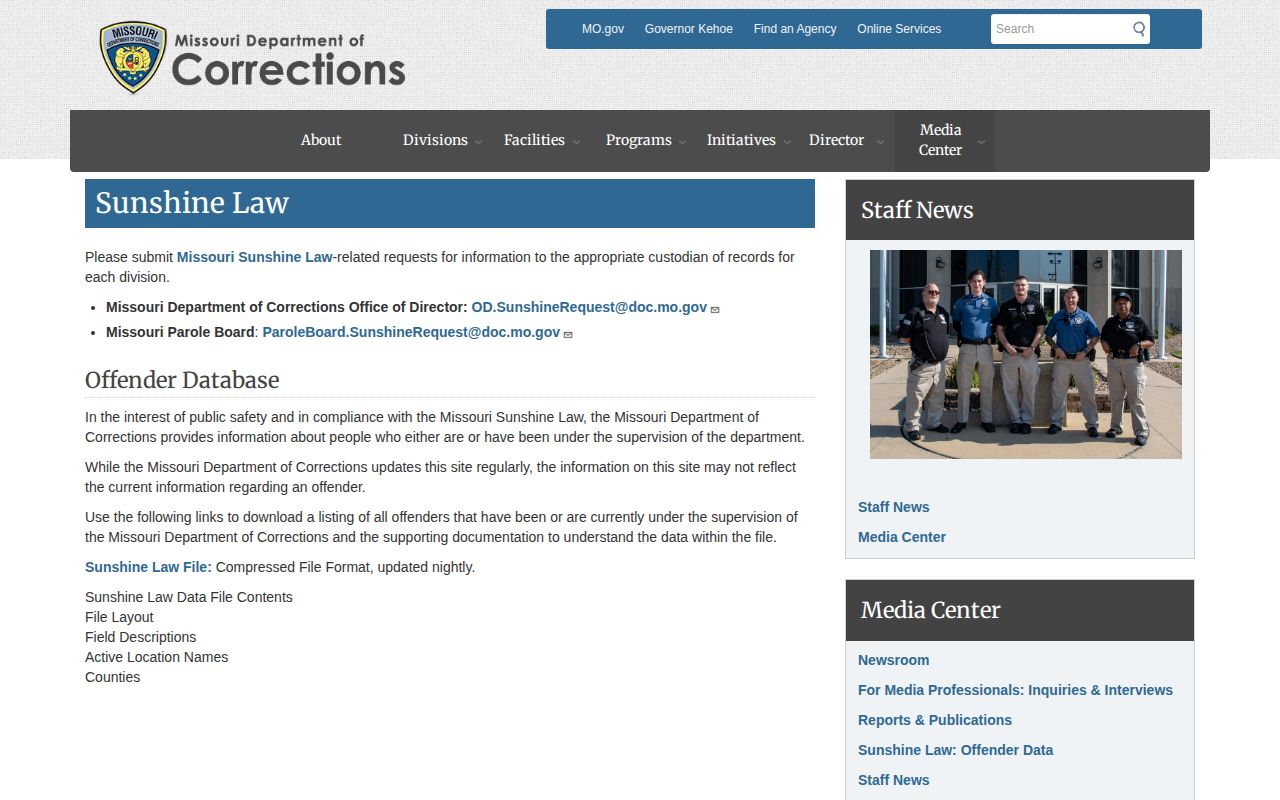
This archive is the key fallback when a fully discharged person no longer appears in the active name search.
Missouri Conditional Release Dates
Section 558.011.4 divides many terms-of-years felony sentences into a prison term and a conditional-release term. For covered terms of nine years or less, the conditional-release portion is one-third of the term. For covered terms between nine and fifteen years, it is three years. For covered terms longer than fifteen years, it is five years. The prison term is the remainder. The statute excludes specified categories, including dangerous felonies and fourth or later MODOC remands, from that default structure.
Conditional release is supervised release, not completion of the sentence. The Missouri Parole Board imposes reasonable conditions, and the Division of Probation and Parole provides supervision. Under subsection 5, the Board can use the prescribed petition and hearing process to extend a conditional-release date, up to the full sentence, for institutional rule violations. A calculated conditional-release point can therefore change before the person leaves prison.
Parole eligibility is different. Eligibility allows the Board to consider release; it does not promise a grant. A parole hearing is not an exit date. Sentence expiration or final discharge is different again because it ends the term if no other sentence or hold applies. Keep all three dates separate when reading a DeKalb County or CRCC record.
DeKalb Minimum Prison Terms
Section 558.019 is Missouri’s minimum-prison-term statute for its covered cases. The applicable percentage depends on the statutory category, offense, criminal history, offense date, and exceptions. The common “85 percent” shorthand is associated with specified dangerous-felony treatment. It is not a rule that every Missouri prisoner must serve 85 percent.
Statutory versions matter because the law has changed. A useful date calculation starts with the judgment and sentence, identifies the offense date and covered category, and applies the version governing that sentence. It then accounts for valid custody credit, consecutive or concurrent structure, board action, and any other sentence. A generic online percentage calculation cannot safely replace that work.
DeKalb Good-Time Release Credit
Section 558.041 is Missouri’s prison good-time authority. On a superintendent’s recommendation, qualifying offenders committed to MODOC may receive additional confinement-day credit under the director’s policy. The statute contains exclusions and permits rescission. Credit applies only to the current sentence. It is not an automatic award that can be calculated from sentence length alone.
Section 217.703 concerns earned compliance credits that may advance completion of qualifying community supervision. That is a different milestone from the day someone physically leaves prison. Using a supervision credit to calculate a prison gate date would mix two stages of the sentence.
These state provisions should not be imported into Daviess/DeKalb Regional Jail. No current public regional-jail good-time policy was located. For a misdemeanor or special county-jail felony term, the jail uses the judgment and credit information it receives. Ask the jail and sentencing court about the specific sentence instead of applying MODOC rules to a local booking.
DeKalb Jail Credit Calculations
Section 558.031 governs credit for time spent in prison, jail, or custody connected to the offense. It also requires the delivering officer to endorse custody dates and credit information on commitment papers. Valid credit can move a calculated date earlier than simple sentence-start-plus-term arithmetic.
Multiple cases make the calculation harder. Sentences can run concurrently or consecutively. A person may have custody credit connected to one case but not another. Revocation time, an amended judgment, an appeal or post-conviction order, and time involving another county may change the inputs. The regional jail relies on the court’s judgment and credit information, while MODOC applies state-sentence records and governing law.
No public weekend-release rule was located for the regional jail. Do not move a computed date to Friday or Monday based on custom from another county. Call the jail and court for the specific term, especially when the date falls near a weekend or holiday.
Why DeKalb Release Dates Change
A projection can move because the source inputs or the legal status changes. Some changes correct an earlier record. Others reflect new court, board, disciplinary, or custody events. The current custodian is the source that can explain which factor affected a specific person.
| Factor | Possible effect on the date | Where to verify |
|---|---|---|
| Jail-credit correction | Valid prior custody may move a calculated date earlier or correct an error. | Judgment, commitment papers, jail, or MODOC record. |
| Concurrent or consecutive clarification | Changes how multiple terms overlap or follow one another. | Sentencing court and sentence record. |
| Amended judgment or later order | Can alter sentence length, credit, or authority for custody. | Case.net and certified court record. |
| Parole action | A grant may set a future date; denial or deferral leaves release for later review. | Missouri Parole Board and MODOC record. |
| Conditional-release extension | Institutional violations can extend the date through the statutory process. | MODOC and Board record. |
| Good-time grant or rescission | Qualifying prison credit can affect confinement calculations. | MODOC sentence calculation. |
| Detainer or new hold | One custody term may end while another agency takes custody. | Release/movement record and receiving agency. |
Confirm a DeKalb Release Date
For the regional jail, compare JailTracker’s actual-release field with the court order and call 660-367-2200. Ask whether the person identified by full name and birth date remains there and, if not, whether staff can provide the date, time, and release or transfer category. If a durable record is needed, request the booking number, out date and time, release authority, release type, and destination or receiving agency under Missouri chapter 610.
For MODOC, use the active offender record while incarceration or supervision continues. After discharge, use the nightly Sunshine file and request the movement or release history. A DeKalb VINE inmate check through MOVANS can provide a pending custody alert, but a notification remains an alert rather than the archival release record. For federal custody, use the BOP locator and federal case sources instead of a Missouri date.
Case.net supplies the legal context for a DeKalb County judgment, bond order, dismissal, or later sentence change. It does not normally function as a jail-door clock. Match its case number to the regional-jail booking or MODOC sentence before joining the records. If one case ends while another hold remains, the first docket may explain a legal release order without proving community release. Ask for the release destination or receiving agency whenever the status could reflect transfer.
Save the source, date accessed, identifier searched, and exact field wording. If a result says “released,” determine which agency released custody and whether another agency received the person. That final distinction prevents a jail transfer from being reported as release to the community.